By Youssef Montasser
Lean Checkouts: Designed for Conversion
Rebuilding the moment every sale is won or lost
Every commerce product has a moment that defines whether it converts: the moment a customer goes to pay.
A first-time shopper has loaded a cart and reached the payment page. A returning buyer is one tap away from a re-order. A high-ticket purchase, a property reservation, a flight, a course, sits in a window of seconds. In every case, the work that preceded that moment, the product, the marketing, the pricing, the trust, is on the line.
And in most checkouts across the region today, that work is being lost in the wrong place.
Cards add friction at the exact moment a customer is most likely to leave. A long card form. A failed 3DS challenge. A declined authorization with no clear reason. A flash of distrust on an unfamiliar checkout page. By the time the customer has decided to abandon, the merchant has already paid for every step that led them there and earned nothing.
Lean Checkouts exists to rebuild that moment around the customer.
Checkouts don't fail in the obvious place
Most conversations about checkout conversion are about the page. The button color. The form fields. The trust badges. The number of clicks.
The real losses happen earlier and later than that. They happen in the rail that processes the payment.
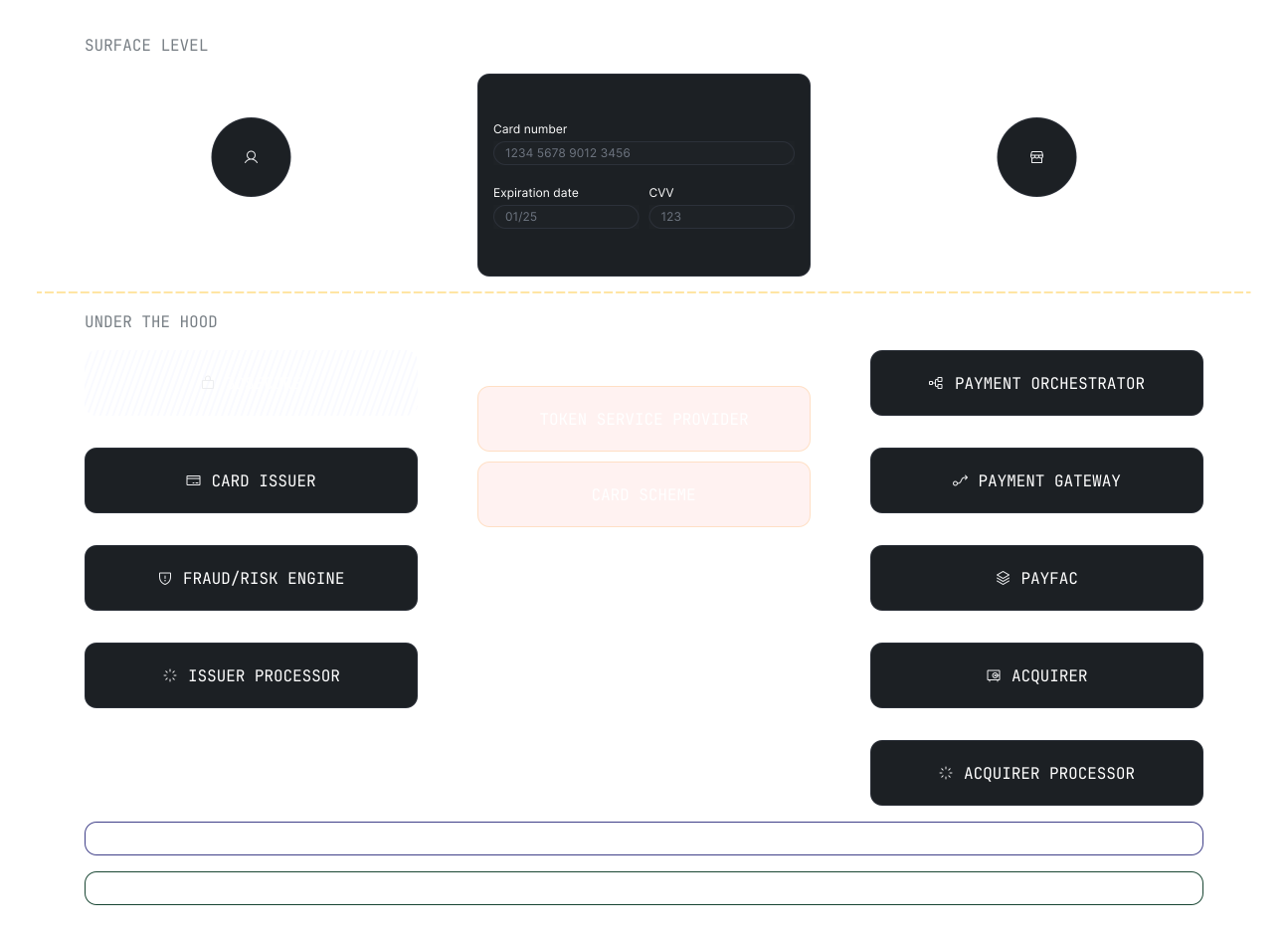
Card-based checkouts depend on a long chain of intermediaries: issuers, schemes, processors, acquirers, each with its own approval logic, fraud rules, and failure modes. Every one of those rules is invisible to the customer and the merchant. A card that worked yesterday gets declined today. A 3DS challenge can force the customer to manually open their bank app, log in, and then find their way back to the merchant's app or browser, often on a slow connection. A first-time buyer hesitates at the request to type a sixteen-digit number into an unfamiliar page. A high-value purchase trips an issuer limit nobody told the customer about.
Even when the payment goes through, the merchant pays a stack of card-related costs: interchange, scheme fees, acquirer or processor margin, gateway or authorization fees, 3DS authentication fees, and chargeback or dispute overhead. Those costs scale poorly on both ends. A low-ticket impulse buy loses a meaningful share of its margin to fixed fees. A high-ticket purchase loses a meaningful share of its margin to percentage fees. The cost of accepting cards is built around averages that do not reflect either end of the catalog.
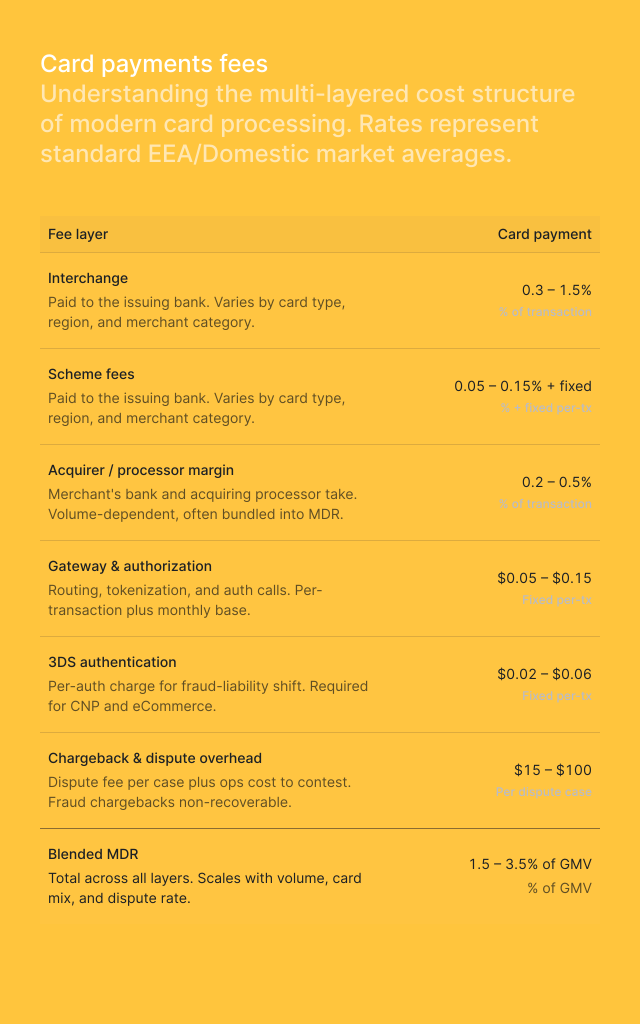
The result is a checkout that fails for reasons the merchant cannot diagnose, at a cost that does not match the product, in a format the customer does not fully trust.
A checkout customers don't have to learn
Lean Checkouts replaces that stack with a bank-authenticated payment that happens inside the customer's banking app.
A customer at checkout picks their bank, reviews the payment details, authenticates inside their own banking app, and is returned to the merchant with a confirmed payment. Four taps. No card details. No OTP entered into a third-party page. No information the customer would not already share with their bank. The bank takes responsibility for the parts of the flow customers worry most about.
Funds settle directly from the customer's bank to the merchant's, in under eight seconds, across eighteen UAE banks. The merchant receives real-time confirmation. Reconciliation is automatic. And because nothing card-shaped is collected, the PCI and fraud surface that comes with card storage simply does not exist.
The flow compounds for repeat buyers. For returning Single Instant Payment users, Lean can skip the bank and account selection steps. With Account on File, the saved bank account turns subsequent checkouts into a single tap, the highest-conversion experience a merchant can offer a returning customer.
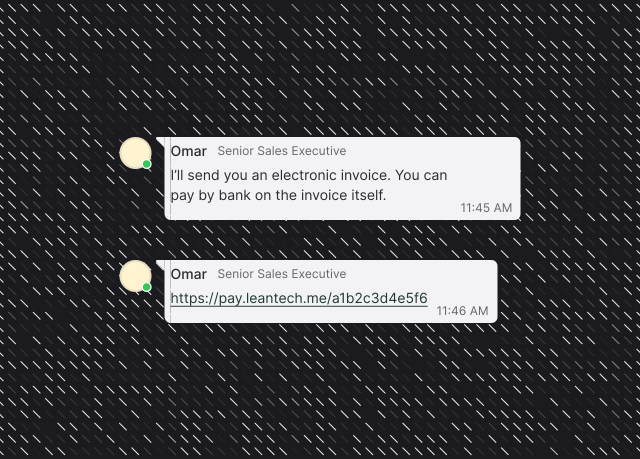
One flow extends the model to commerce that does not happen on a checkout page at all. Payment Links let sales agents, customer service reps, or finance teams send a payment request directly to a customer over WhatsApp, SMS, email, or QR. The customer taps, authorizes in their bank app, and the payment lands cleanly attributed to the right order. The link is the checkout. For invoices, social commerce, and remote sales where the customer never sees a traditional storefront, that is the entire experience.
The infrastructure underneath
Checkouts is not a feature. It is a product built on infrastructure that took years to put in place.
In the UAE, Lean Checkouts runs on the Central Bank of the UAE's Open Finance framework known as AlTareq, and settles over Aani, the instant payment rail that runs 24/7/365. Strong Customer Authentication is enforced at the bank level. Lean is licensed and regulated by ADGM, holds in-principle approval from the UAE Central Bank under the Open Finance framework, and was the partner behind the country's first live customer-initiated Open Finance payment earlier this year.
That foundation lets Checkouts do something cards structurally cannot: authenticate inside the customer's own banking app, automatically settle account-to-account instantly, at a fraction of the cost of card networks, across eighteen UAE banks, inside a single API.
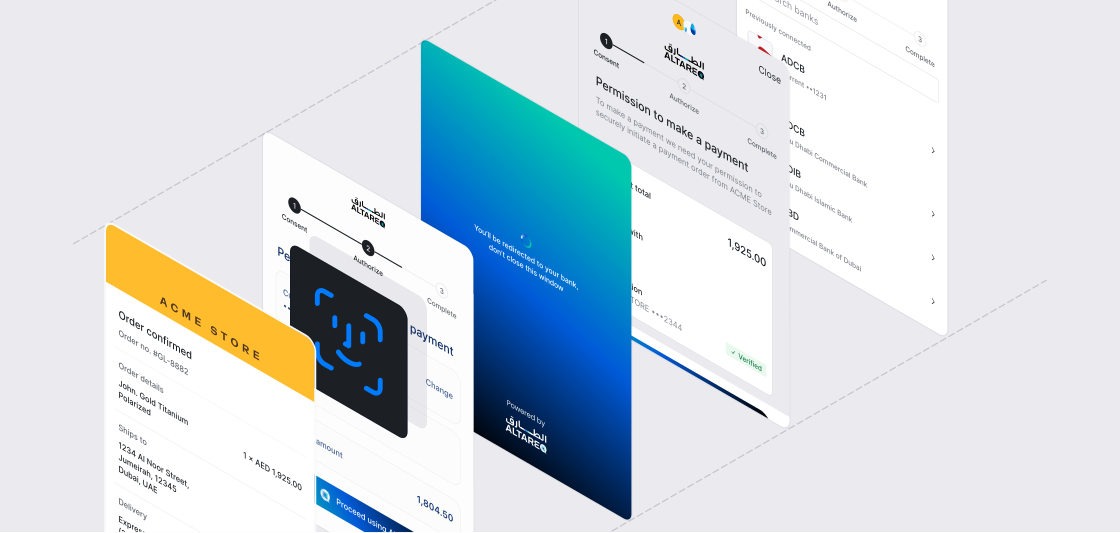
It is the part the customer never sees. It is the part that makes the rest of the experience work.
Where Checkouts matters most
Checkouts creates the most value in commerce products where conversion is the dominant metric and card economics work against the business model. Three are leading the shift in the UAE.
eCommerce: where every percentage of conversion matters
In eCommerce, checkout abandonment is the single largest leak in the funnel. A meaningful share of customers reach a cart, reach a payment page, and leave. Some of them leave because the price was wrong. Most of them leave because the checkout was wrong: too long, too unfamiliar, too distrusting, or just slow enough to compound buyer doubt and turn a "maybe now" into "maybe later" or no purchase at all.
A bank-authenticated checkout closes most of that leak in one move. The customer does not type a card number into an unfamiliar page. They authenticate inside the app they already trust, see a confirmed payment, and return to the merchant with the order placed. For repeat customers, Account on File compresses every future purchase into a single tap. For first-time buyers, Single Instant Payments removes the entire card form and replaces it with a bank handshake the customer already knows how to do.
Marketplaces: where conversion meets fulfillment
For marketplaces, the checkout is not only the moment of conversion. It is the moment fulfillment begins. A confirmed payment is what triggers the seller to ship, the driver to dispatch, the partner to deliver. An ambiguous payment status, a pending card authorization, a transaction in flux: all of those force the marketplace to choose between two bad outcomes, fulfill at risk, or hold the order and frustrate the buyer.
Real-time bank-authenticated payments remove that ambiguity. Every successful payment is final at the moment of authorization. The marketplace can dispatch with confidence and reconcile against a single source of truth. Disputes drop because there are no chargebacks to manage in the same way. Fraud surface contracts because nothing card-shaped is stored anywhere on the marketplace's stack.
High-ticket purchases: where card economics break
For real estate, travel, automotive, and other high-value commerce, the card model breaks at both ends. Percentage fees become material. A five-figure purchase puts hundreds of dirhams of margin onto the card networks. Card limits cap the transaction at a number that frequently sits below the actual sale. And the customer's trust at a high-value moment is fragile in a way it is not for a coffee or a t-shirt.
A bank-authenticated checkout fixes all three. There is no percentage fee on a card network because there is no card network. There are no limits to navigate because the customer is authorizing a transfer from their own account in the bank they already use. And the moment of authorization happens inside the customer's banking app, the most trusted surface in the entire purchase journey.
What changes when the checkout matches the customer
Across these industries, the same pattern shows up.
Conversion rates rise. Replacing card friction with bank-authenticated payments removes the largest single source of payment-related abandonment, and Account on File compresses every repeat purchase into one tap. That is the moment checkout stops being a UX surface and becomes a habit.
Costs come down. Bank-to-bank payments operate at a fraction of card economics, which means margin returns on both low-ticket and high-ticket commerce. Across Lean's customers, this shift has driven more than $100 million in card fee savings to date.
Fraud and PCI overhead drops. Without card details collected or stored, the surface for the most common card-related fraud and compliance burdens contracts sharply. The dashboard gives finops, developers, and compliance the same view, on the same source of truth, in real time.
Fulfillment gets faster. Real-time confirmation means the moment of conversion is also the moment fulfillment can begin, with no waiting for settlement to clear or for a card authorization to firm up.
None of this is theoretical. Lean is running this today across more than 350 customers and over $4 billion in processed volume, with checkout flows live across eCommerce, marketplaces, real estate, travel, and crypto.
Checkout is the product
The fastest commerce products in MENA are not the ones with the prettiest pages. They are the ones where the moment of conversion has been built into the rail underneath.
Lean Checkouts is how the region's leading marketplaces, eCommerce platforms, and high-ticket merchants are building it. Infrastructure that is regulated, real-time, and built on the bank account the customer already trusts.
In commerce, the checkout is not a step. It is the conversion.
Continue reading
Pay by Bank: The Next Evolution of Digital Payments in the UAE
Lean Collections: Automated Repayments in the UAE
For businesses that collect repayments over time, reliability directly affects cash flow, operating cost, and customer experience.